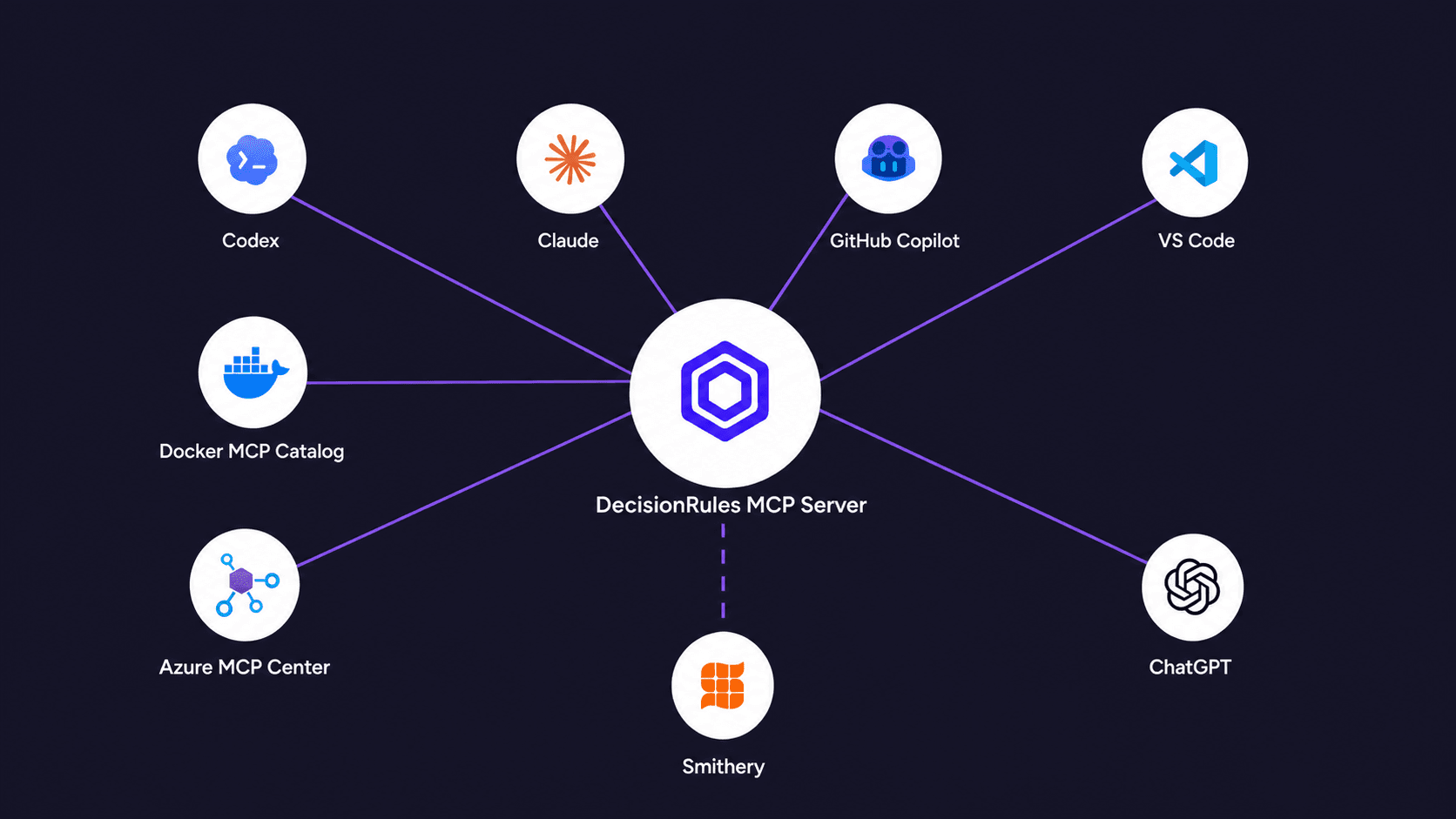







Native MCP Integration
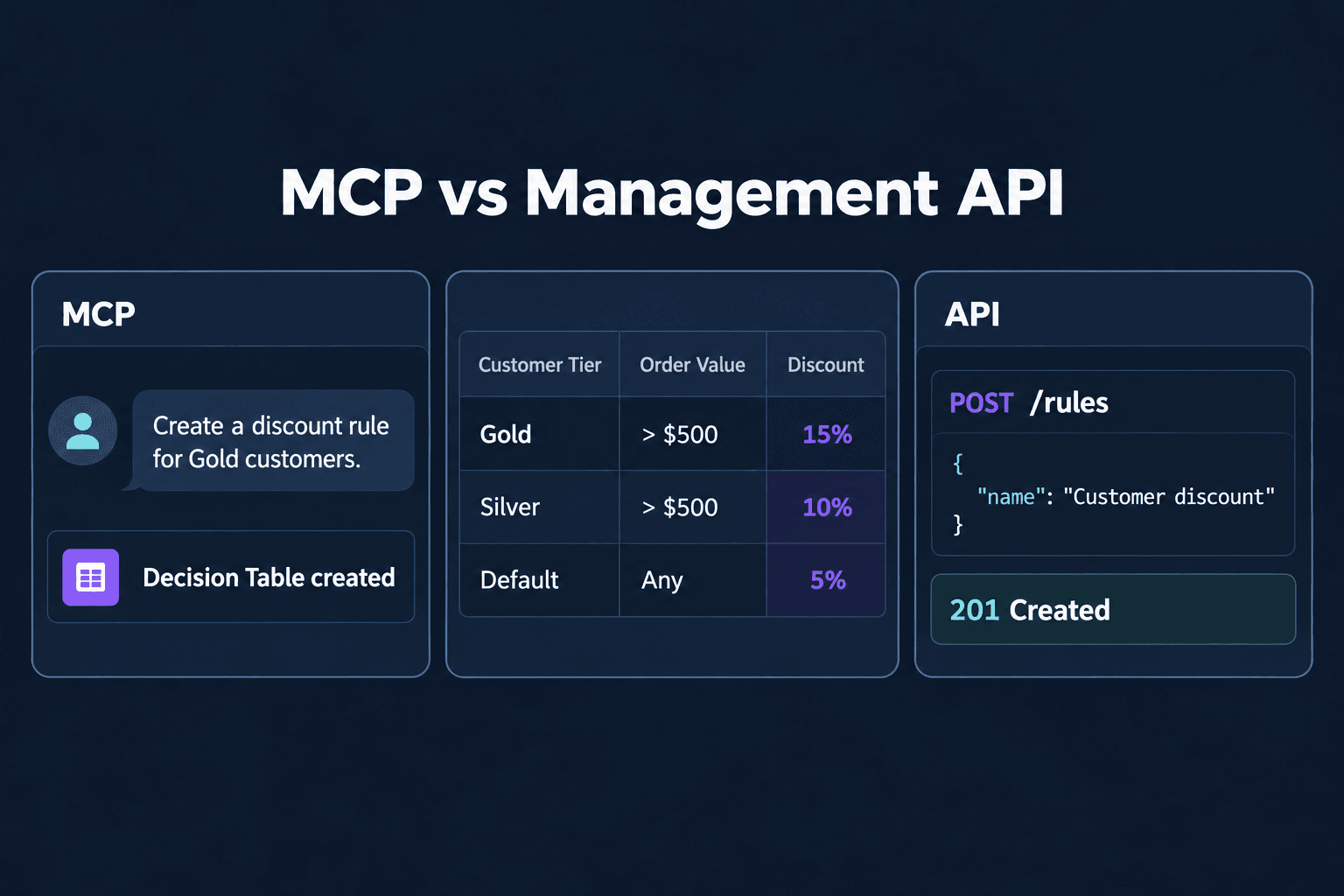
Any MCP-compatible AI tool, such as ChatGPT, Claude or Copilot, can create, update, test and run your rules directly in DecisionRules.
AI-Powered AI AGENTS · MCP SERVER
A modern decisioning platform for dynamic pricing, credit scoring, claims processing, risk, fraud, and data validation. Your business teams update rules. Your engineers keep architectural control.
Global proven Excellence
FINANCIAL SERVICES, INSURANCE, E-COMMERCE, LOGISTICS, HEALTHCARE, TELECOMMUNICATIONS, ENERGY, AVIATION, GOVERNMENT, AND EDUCATION.
See how your decisions can run automatically. Pick an example below or write your own.
Our AI Assistant is built for creating decision rules and sets yours up for you to try in DecisionRules.
The Solution
DecisionRules empowers business and IT to collaborate seamlessly on a proven, AI-driven platform that scales precisely with your needs. Avoid expensive monolithic bloat and accelerate deployment with measurable AI tools and dedicated in-house architectural support.


Only pay
for what you need
No monolithic suites. No paying for features that sit on a shelf. Add use cases, users, and environments at your own pace.

No-code design
meets full API access
Your business team designs rules visually. Your engineers integrate via REST API and manage deployment. Both work in one platform, not in silos.

AI decisioning. Measured, not hyped.
AI Assistant for ~60% faster rule authoring. Document intelligence, bring-your-own model, and ready-to-use AI agents, all benchmarked in a controlled experiment.
Dedicated Professional Services
Our team helps with architecture design, rule migration, and onboarding. Work with the platform creators.

Jannik William F.
Enterprise Architect, COOP Bank, G2 Verified Review
DecisionRules nails the balance between user-friendly UI and powerful logic. We have SMEs who can understand the logic and make adjustments as needed, while developers can extend it.
The Build-First Path
Organizations with technical talent that want to own and shape their tools. You control the architecture.
What you get
Start with what you need, add as you grow
Your architects design it, your teams extend it
IT and business collaborate in one platform
What it means long-term
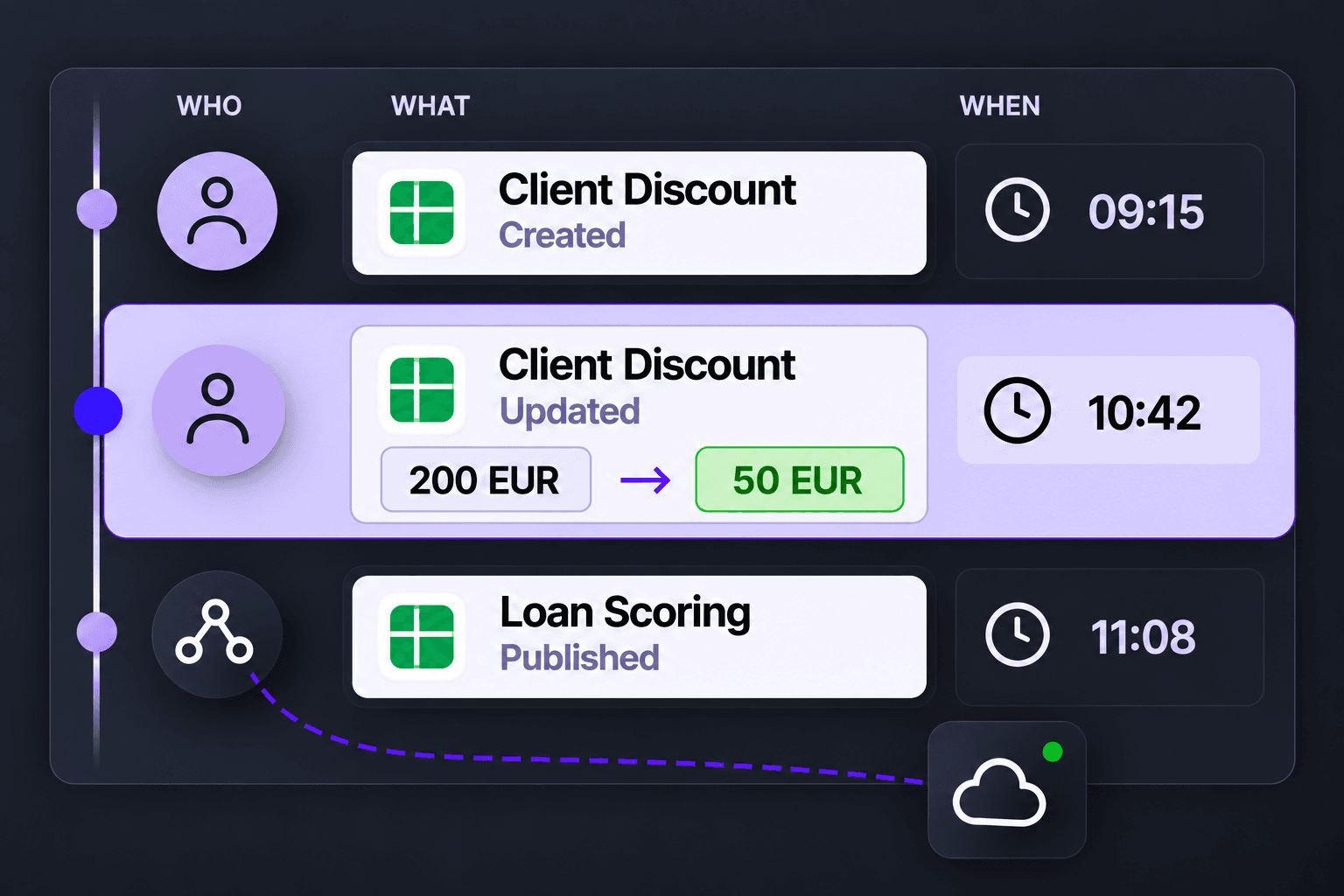
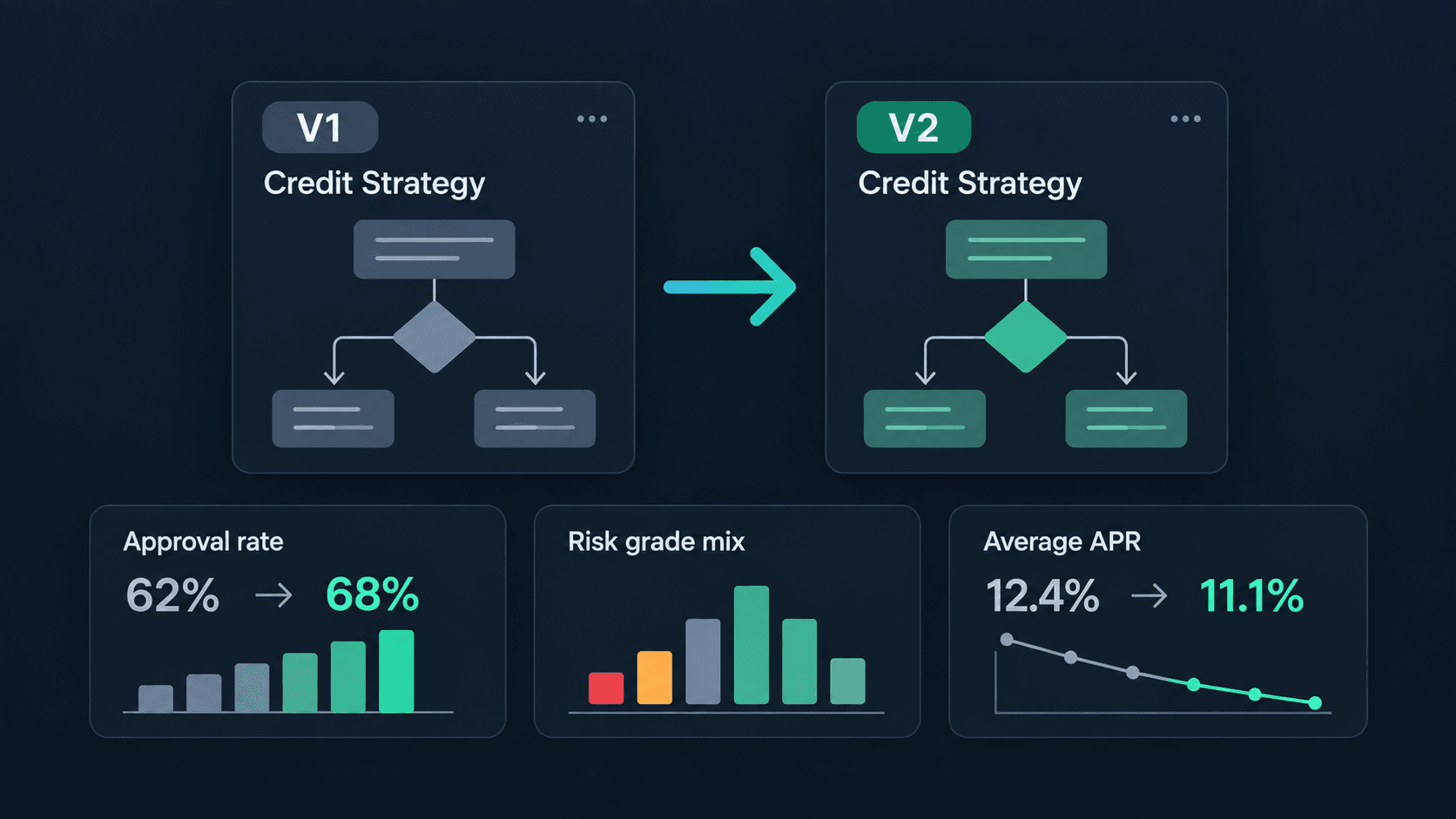
Every change versioned, every decision auditable
Never locked into one ecosystem
Architecture stays flexible as requirements evolve
Solutions
Platform

Full version control for engineering
Business analysts define rules in a spreadsheet-like interface. Engineers integrate and deploy through the same platform. Every change versioned, every decision auditable.
DecisionRules supports a wide range of integrations with your systems and data sources.


AI Capabilities
Every AI claim on this page comes from a controlled experiment. No guesswork, no inflated numbers.
Measured
~60%
Faster rule authoring
Effectivity
3x
Daily productivity increase
Precision
80%
Chat sessions rated as very helpful
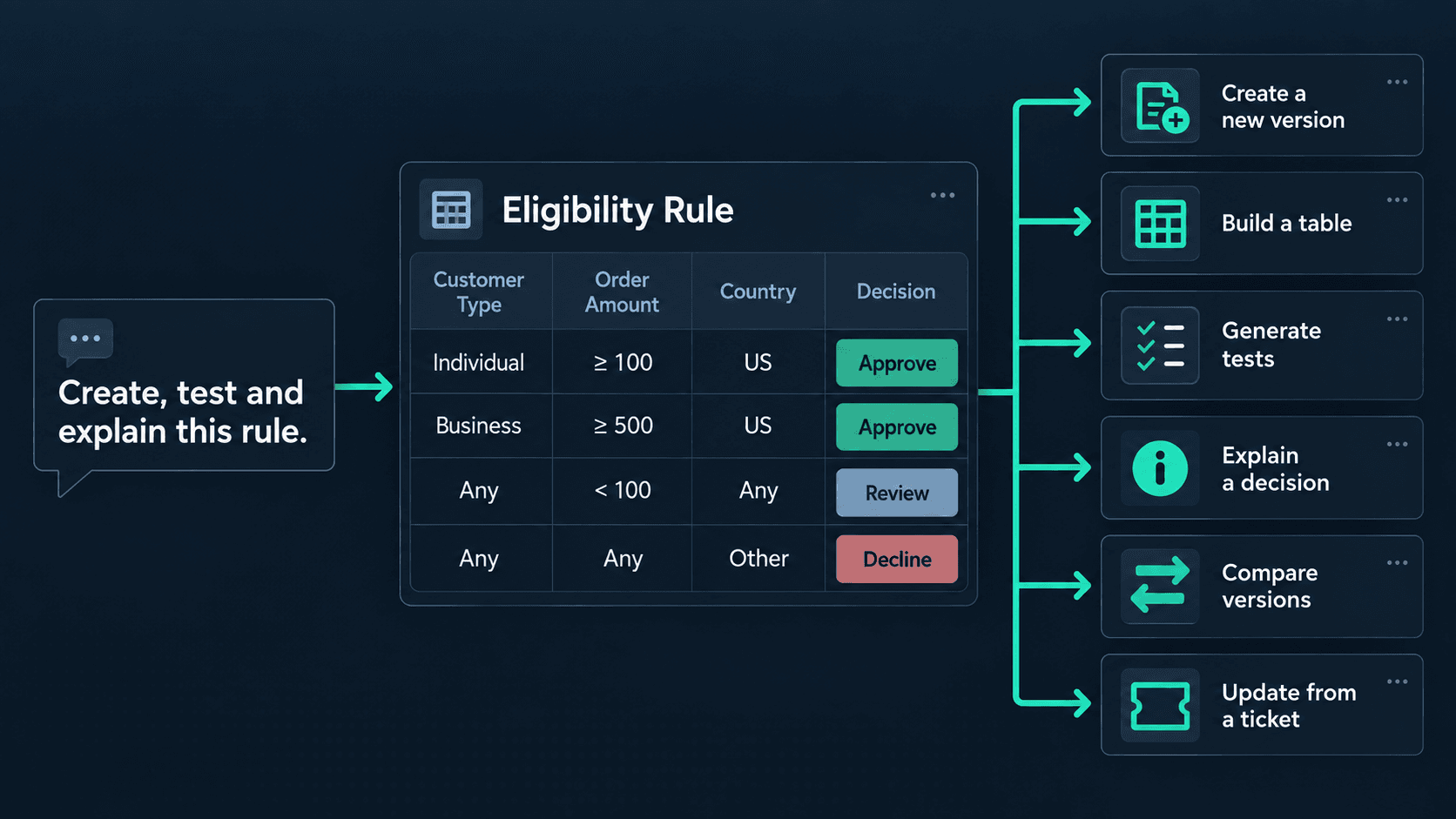
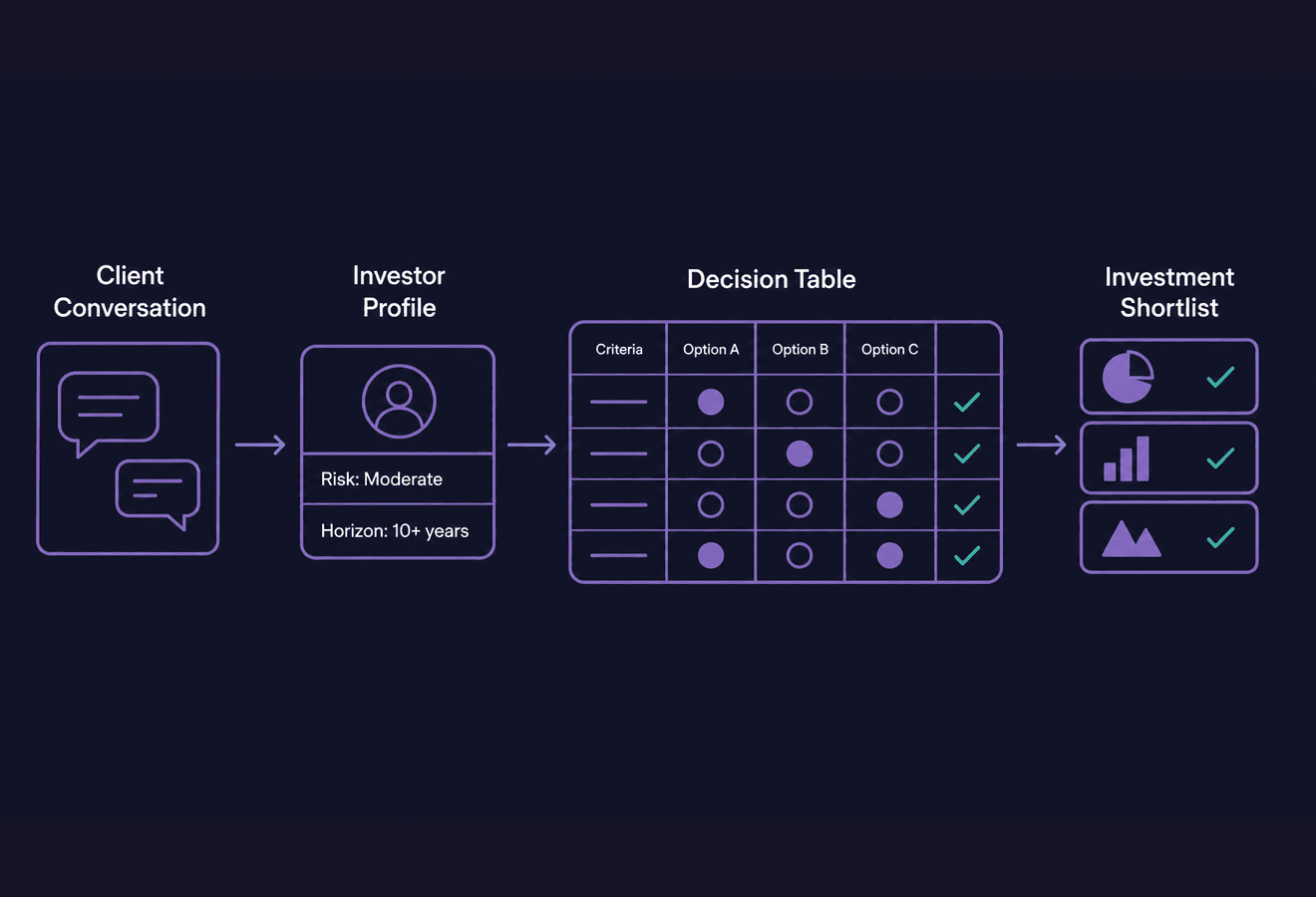
Describe what you need in plain language. The AI Assistant creates:
Decision tables
Suggests improvements
Edits existing rules
Generates test data
Sentiment analysis, entity recognition, classification, and data enrichment. Production-ready AI agents that run inside your decision flows, not beside them.
Any MCP-compatible AI tool, such as ChatGPT, Claude or Copilot, can create, update, test and run your rules directly in DecisionRules.
Feed PDFs, Excel files, and scanned documents into your decision flows. AI extracts, validates, and enriches your data with no manual entry and no custom code.

Turn on Explainable AI and every AI Agent result comes with a confidence score, the reasoning and the source passages it used.
Feed OCR and document outputs straight into your decision logic. Extract, validate, and route without custom code.

Turn policy documents into live decision logic with no need to rebuild them as decision tables. DecisionRules reads and enforces your policies as they are.


For developers
Scalable REST API, native SDKs, Docker and Kubernetes ready.
Deploy on Cloud or On-premise with a Git-friendly workflow.
Our plans
Startups & Small Businesses
Start using DecisionRules in 2 minutes with our easiest and most affordable option — no setup, no overhead.
Medium & Large Businesses
Need a private setup without the hassle? Get full data control while we handle deployment and maintenance.
Enterprise
Full control for enterprises with strict security or compliance needs. Your team manages the environment.
Our Services
Our Team
You’re working with the people who built the platform.
Training and Onboarding
Custom training for your use case, led by in-house experts. Get your team building rules independently.
Explore training and onboardingProfessional Services
Architecture design, rule migration, and production support from initial setup to scale.
Explore professional services
Global network, local expertise
Our certified partners help you implement, scale, and optimize DecisionRules in your language, in your timezone, and in your market context.
USA
Europe
LATAM
APAC
Africa
We’ll help you design a clear path to centralized, transparent, and automated decision-making.
Book a demoNeed Help?
We’re here to help with any questions you have about plans, pricing, and supported features.
It depends on how much architectural flexibility you need and how many use cases will share the platform. A specialized vertical tool makes sense when you need a single, well-defined process out of the box and you're willing to pay enterprise license costs for vertical depth. A BRMS makes sense when you want to keep flexibility, avoid vendor lock-in, and reuse one platform across multiple processes over time.
The deciding factors are usually: how unique is your logic, how often will it change, how many use cases will share the platform, and how much you value owning it versus renting it. Organizations with a strong CTO or Enterprise Architect voice and a "we'd rather own it" mindset consistently choose the BRMS path.
DecisionRules works for both technical and business-led teams. The initial setup involves IT for integration, but day-to-day rule authoring sits with business analysts, risk teams, or pricing teams in a visual editor. You don't need a large engineering team to run it.
DecisionRules connects to your stack through a well-documented REST API. Your application sends input data, the engine evaluates the rule, and returns the decision. The same pattern works whether you're calling from a CRM, an ERP, a core banking system, a loan origination platform, or a custom application.
For most teams, integration takes hours, not weeks. We provide official SDKs for JavaScript, Node.js, Java, .NET, Angular, React, Python, PHP, Go, and Oracle PL/SQL, plus ready-to-use code snippets inside every rule. There are also native nodes for n8n, Zapier, and Apache Kafka, an Excel Add-In for testing rules against real data, and a native Power BI integration for analytics on rule outcomes.
When you need DecisionRules to pull data from external systems during evaluation, our Decision Flow includes REST API Client nodes and DB Connectors with secure credential management. You stay in control of where data lives and how it flows.
DecisionRules offers three deployment options. Public Cloud runs as SaaS on AWS, with hosting regions in the US and Europe so you choose where your data resides. Private Managed Cloud gives you a dedicated environment with the same managed experience. Self-Hosted lets you run DecisionRules in your own infrastructure via Docker or Kubernetes, including air-gapped environments.
On the security side, DecisionRules is ISO 27001 certified and SOC 2 audited by BDO. Both reports are available under NDA. We're GDPR compliant with a designated Data Protection Officer.
The platform includes audit logging on every rule change and execution, multi-factor authentication, role-based access control with default and custom roles, and SSO integration with your identity provider. Data is encrypted at rest using cloud-managed keys and in transit via TLS. Annual penetration tests are run by independent contractors, and Docker images are continuously scanned with a maximum 14-day remediation window for any identified vulnerability.
For full details and to request our SOC 2 report, see our Trust Center.
The AI Agent is a native rule type that brings interpretation and reasoning capabilities into your decision processes. Unlike traditional Decision Tables that rely on explicit, hard-coded conditions, the AI Agent leverages large language models (LLMs) to understand context and unstructured data.
Within DecisionRules, it primarily handles three types of tasks:
The AI Agent is not a chatbot—it is a fully integrated component of your decision engine, callable via the same REST API as any other rule. It allows you to automate the ambiguous, language-heavy parts of your business logic that previously required manual human review.
Most teams have a working proof of concept inside two weeks. A first production use case (one process, a few rule sets, integration with one system) typically goes live in 4 to 8 weeks. Migration from a legacy decisioning platform takes longer because of testing requirements, with mid-complexity processes typically migrating in roughly 10 to 18 days of focused work plus regression testing.
You can start without talking to anyone. Sign up for the free tier, build a Decision Table, and call it from your application via API. Most developers have a working rule running inside 30 minutes. If you're evaluating DecisionRules for an enterprise use case, regulated environment, or migration from an existing platform, book a demo and we'll walk through your specific scenario.
DecisionRules has two distinct AI capabilities: the AI Assistant and AI Agent. They serve different purposes.
The AI Assistant is a build-time tool that helps teams create, edit, test, and understand decision logic. Describe what you need in natural language, and it can create Decision Tables, Scripting Rules, Lookup Tables, and complete Decision Flows. For more complex processes, it can help turn business requirements into connected rules and flows.
The Assistant can also generate test data, write and explain functions, summarize existing logic, work with uploaded documents and structured data, recommend templates, and answer questions about the DecisionRules platform.
The AI Agent is a runtime rule type. It uses large language models during rule execution to interpret unstructured information and return structured outputs that can be used by other rules and Decision Flows. For full technical details on the AI Agent rule type, see our documentation.
The AI Assistant helps you turn business requirements into working decision logic directly inside DecisionRules. It can create Decision Tables, Scripting Rules, Lookup Tables, and Decision Flows from natural-language instructions, uploaded documents, or structured data.
It also helps you work with existing logic: generate test data, write and explain functions, summarize rules, and guide you through the DecisionRules platform using information from the official documentation and Academy.
For more complex requirements, the Assistant can help design processes that combine multiple rules and flows, reducing the manual work needed to move from a business requirement to an executable decision process.
A BRMS is software that lets organizations define, manage, and execute business logic separately from application code. Instead of hard-coding policies, pricing tiers, eligibility checks, or scoring models inside individual systems, teams maintain them in one place and call them through APIs.
This separation matters because business rules change far more often than the systems that use them. A bank might update its risk thresholds quarterly. An insurer adjusts underwriting criteria by region. An e-commerce platform tweaks pricing rules weekly. With a BRMS, those updates happen in a visual editor and go live without a software release.
DecisionRules is a cloud-native BRMS built around Decision Tables, Decision Trees, Decision Flows, and Scripting Rules. It evaluates rules through a REST API and is used across credit scoring, pricing, fraud detection, eligibility, and routing in financial services, insurance, e-commerce, healthcare, and logistics.
Blog
View all articles